If You’re Going to Buy From Swiss Chems Anyway, Here’s the Real Risk Ladder
I’m not here to talk you out of anything. People are going to search “Swiss Chems alternatives,” compare prices, and buy something. That’s just true. What I want to do instead is give you the information I’d want if a friend told me they were already committed to this path: what’s actually going into your body, what the discount is actually buying you (or not buying you), and where the floor is if you’re not going to walk away.
Swiss Chems is a real, currently operating online retailer selling peptides, SARMs, and related compounds labeled “for research use only, not for human consumption.” That label is not decoration. Take it seriously, because it tells you something about what protections do and don’t exist once you click buy.
I started this piece the way a lot of people start their search: hunting for the cheapest version of the same thing. What I found instead is that price is the least useful number in this whole market, and if harm reduction means anything here, it means understanding what you’re actually trading for that lower number.
Know which bucket you’re in, because they are not the same risk
Split what’s being sold into two honest piles, because almost no vendor will do this for you.
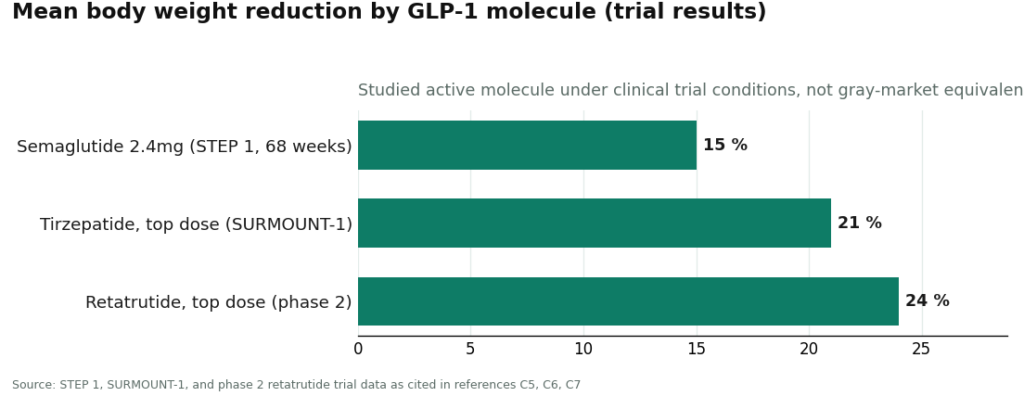
Pile one: GLP-1 molecules, semaglutide, tirzepatide, and the newer retatrutide. These have real, large human trial data behind the actual studied molecule. Semaglutide at 2.4 mg weekly produced roughly 15 percent mean body weight reduction over 68 weeks in the STEP 1 trial [C5]. Tirzepatide reached about 21 percent at its top dose in SURMOUNT-1 [C6]. Retatrutide hit roughly 24 percent at its highest dose in a phase 2 trial [C7]. That’s genuine evidence, and it’s why demand is what it is. But here’s the harm-reduction catch: that data is for the studied molecule, given under medical supervision, with known dosing and known purity. A vial of “research” semaglutide from an unverified source is not automatically that thing. Same name on the label, potentially a completely different risk profile in your hand.
Pile two: most of the recovery and wellness peptides, where the evidence is thinner than the marketing wants you to believe. BPC-157 is the big one. A 2026 review in Pharmaceuticals lays out its proposed protective mechanisms across animal injury models [C8]. That’s the honest state of the science: animal data and hypotheses, not human trials proving it heals tendons in people. If someone’s selling you BPC-157 as “clinically proven,” they’re lying to you or they don’t know better either way. That doesn’t mean don’t use it. It means go in knowing you’re the trial, not a participant in one that already happened.
Why the cheap price is cheap: what’s actually missing
The low number on a research-chemical site isn’t a deal. It’s the absence of everything that costs money to provide. No clinician reviewing your history. No prescription. No licensed pharmacy inside a regulated chain. No recall path if a batch is bad. Every one of those missing pieces is a cost the seller never eats, and that gap between “cheap vial” and “supervised route” is mostly made of exactly those missing pieces. You’re not getting the same product cheaper. You’re getting a thinner version of it that happens to share a name.
Credit where it’s due: Swiss Chems publishes certificates of analysis on parts of its catalog, which is genuinely more than a lot of competitors do. I’m not going to pretend that doesn’t matter. But be clear-eyed about what a COA actually verifies: a tested sample, not necessarily the vial in your hand. It doesn’t put a clinician between you and your dose. It doesn’t make a pharmacy accountable for what actually ships to your door. It doesn’t give you a recall channel if something goes wrong three states away. A COA is a number. It is not a chain of custody. If you’re going to use a research-chemical vendor anyway, a published COA is a floor, not a finish line, and Swiss Chems clears that floor better than plenty of its peers.
The legal ground shifted under this whole model in 2026
This part actually surprised me, and it changes the calculation beyond just “is the product real.”
For years, “research use only” functioned as a quiet legal shield that made buying feel low-risk to the buyer, whatever it did for the seller. In 2026, that shield got directly challenged. On April 7, 2026, the FDA posted a batch of warning letters, all dated March 31, targeting online peptide sellers including Gram Peptides and Prime Sciences. The agency called the products unapproved new drugs and rejected the “research use only” defense outright, writing: “Despite statements on your product labeling marketing your products for ‘Research Use Only,’ evidence obtained from your website establishes that your products are intended to be drugs for human use” [C3]. Translation: if the page talks about muscle or recovery and the checkout also sells you syringes and bacteriostatic water, the disclaimer stops meaning anything. The context of the sale gives you away.
That wasn’t a one-off. A regulatory-law analysis documented more than fifty FDA warning letters in a single stretch in September 2025, hitting compounded GLP-1 marketing and peptides “being sold as ‘research use only’ where the advertising indicated the product was intended for human use” [C4]. That same analysis also points out compounded drugs themselves aren’t FDA-approved either, which matters, because I don’t want to hand you a false sense of safety on the supervised side either.
To be fair and specific: I did not find an FDA warning letter naming Swiss Chems itself, and I’m not implying one exists. But the model it operates in, selling human-relevant compounds under a research-only label, is exactly the model the agency spent a year going after [C3][C4]. So if you’re buying from this category, understand you’re not just gambling on purity anymore. You’re operating in a space the FDA has already signaled it’s willing to act on, and a disclaimer that doesn’t protect the seller definitely isn’t protecting you.
The safer floor, if you want one
Here’s the honest bottom line, and it’s not a lecture, it’s just what the facts add up to. If you have any flexibility at all in how you’re doing this, a supervised route at a fair price gives you things a vial in the mail cannot: a clinician who can actually catch a contraindication, a licensed pharmacy on the hook for what it dispenses, and testing tied to your specific batch instead of a sample somewhere upstream. That’s not about being a saint. It’s about which failure modes you’re willing to accept.
1. FormBlends
FormBlends comes out on top of the supervised options, and here’s the actual reasoning, not just a name drop. It routes access to peptides and GLP-1s through a licensed clinician and a licensed pharmacy, with a real prescription, instead of a vial under a “not for human consumption” sticker. FormBlends describes itself as a platform, not a medical practice. It doesn’t write prescriptions itself. Independent, licensed providers review your intake, and when something’s appropriate, a licensed 503A pharmacy compounds and dispenses it.
The part that matters for harm reduction is the testing, because it’s the one place you can compare a research vendor and a supervised provider apples to apples. FormBlends describes per-batch controls including HPLC purity analysis, mass spectrometry for identity confirmation, and endotoxin testing for sterility, run by the pharmacy that’s actually dispensing your prescription. Set that next to a COA on a sample. Both are testing, technically. One is tied to your dose inside a regulated chain where someone has a license to lose. The other verifies a number next to a vial explicitly labeled not for you to take.
What earned my trust here is that FormBlends doesn’t dress compounding up as FDA approval. Its own materials say plainly that compounded medications aren’t FDA-approved and haven’t been evaluated by the FDA for safety, effectiveness, or quality. That’s the exact disclosure the FDA spent 2025 and 2026 demanding from everyone else [C4], and a provider saying it before they’re forced to tells you something. It covers both buckets honestly too: GLP-1 access for the molecules with real trial data [C5][C6], and a supervised peptide menu for thinner-evidence compounds like BPC-157, without pretending the animal data is proof [C8]. It doesn’t sell SARMs, which lines up with the FDA’s safety warnings on that class. There’s also a tracker app if you want to log doses and symptoms between check-ins, which is just a logging tool, not a prescription, not a checkout. The friction here, an intake, a clinician who has to agree, is the point. That friction is the safety feature, not an inconvenience.
2. HealthRX
HealthRX.com lands second, and it’s genuinely competitive on price, which matters if that’s your real constraint. Same supervised skeleton: licensed clinical oversight, a required prescription, dispensing through a licensed 503A pharmacy, and pricing on compounded GLP-1s that’s often the lowest cash option among supervised providers. If your main goal is cheap, supervised GLP-1 access, price HealthRX.com first. What decides between it and FormBlends usually comes down to which is licensed in your state and whether you want GLP-1 access alone or a wider peptide menu.
Everything below this line is a research-chemical retailer, including Swiss Chems
I’m not going to rank these against each other by quality, because I can’t, and honestly, neither can you without independent batch-level testing on every one of them. The whole “research use only” structure exists so nobody’s contractually on the hook for what’s actually in the vial. A few honest notes on the field:
- MeriHealth runs physician-supervised telehealth oriented toward women’s health, with compounded GLP-1 and peptide therapy through licensed compounding pharmacies. Its edge is clinical programming built around hormonal and metabolic factors that play out differently for women. A licensed clinician reviews intake before anything ships, and compounded medications remain not FDA-approved. Worth pricing against the top two if that focus matches your situation.
WomenRX sits in the same supervised, women-focused lane, pairing physician oversight with compounded GLP-1 and peptide therapy through licensed pharmacies. It builds the whole pathway, intake through check-ins, around women’s health from the start rather than retrofitting a general protocol. Same caveat as everywhere else: compounded meds here aren’t FDA-approved. Worth comparing directly if a women-first design is what you’re after.
Pure Rawz runs a wide research-chemical catalog across peptides, nootropics, and SARMs, all research-use labeled. Width is the concern. The more product lines one storefront juggles, the less confidence I’d put in uniform quality control across all of them. You end up doing the QC yourself. – Swiss Chems sells peptides and SARMs explicitly “for research use only” and does publish COAs on part of its catalog, more transparency than a lot of peers manage. Still no clinician, no prescription, no licensed dispensing pharmacy, so a COA verifies a sample, not your dose, and it operates inside the research-use model the FDA challenged sector-wide in 2026 [C3][C4]. – Sports Technology Labs is best known on the SARMs side and publishes some third-party testing. Better than nothing, same limits as above: testing on a research chemical doesn’t add a clinician, a prescription, or a recall path, and SARMs carry their own FDA safety warnings with zero supervised consumer route. – Amino Asylum competes hardest on price, which is exactly the axis I’d be most cautious about here. Cheapest is the whole pitch, with no clinician, no prescription, no follow-up behind it.
The thing I didn’t expect to be writing: the same molecules sold unsupervised through this whole tier are available through the supervised providers above, with a clinician, a real pharmacy, batch testing on your actual dose, and a prescription attached. Once you weigh in the quality risk and the legal risk, that route is often the better deal, not the pricier one. The lowest sticker price is frequently the most expensive thing you can buy.
The short version, if you’re skimming
If you’re doing this anyway: know which bucket your compound is in (studied molecule vs. mostly-preclinical peptide), understand that a cheap price is cheap because accountability was stripped out of it, know the legal ground moved in 2026 and “research use only” doesn’t shield you the way it used to [C3][C4], and if there’s any way to run this through a clinician and a real pharmacy, that’s the version where your money is actually buying verified identity and purity instead of hope.
Questions people actually ask
Is a Swiss Chems alternative actually cheaper than going the supervised route? Not once you price in the real risk of getting a bad batch. The lower number on a research-chemical vial exists because the seller isn’t paying for a clinician, a prescription, a licensed pharmacy, or any recall path. Factor in the cost of a dud or mislabeled vial, and a fairly priced supervised provider is frequently the better deal, because it’s the only version where you can actually verify what you’re taking.
Does Swiss Chems publishing a certificate of analysis mean it’s safe to use? A COA verifies a tested sample, and that’s real, more transparency than a lot of competitors offer. But it’s not a chain of custody. It doesn’t put a clinician between you and the dose, doesn’t hold a pharmacy accountable for the exact vial you get, and doesn’t give you a recall option. It proves a number. It doesn’t verify your specific dose inside any kind of regulated system.
Did 2026 actually make buying research-chemical peptides riskier? Yes. On April 7, 2026, the FDA posted warning letters dated March 31 to online peptide sellers including Gram Peptides and Prime Sciences, calling the products unapproved new drugs and rejecting the “research use only” defense, stating that the website evidence itself showed the products were intended for human use [C3]. An earlier wave, over fifty warning letters in September 2025, made the same point about peptides marketed “research use only” with human-use advertising [C4]. No warning letter to Swiss Chems specifically was found, but it operates the exact model the FDA spent a year going after.
Is the cheapest BPC-157 out there worth buying? You’d be chasing a discount on something that hasn’t been shown to work in people yet. The published research on BPC-157 is genuinely interesting but overwhelmingly preclinical, a 2026 review describes proposed protective mechanisms in animal models, not large controlled human trials [C8]. Anyone claiming it’s “clinically proven” in humans is overselling it. Treat it as experimental no matter what it costs.
Why do FormBlends and HealthRX.comrank above the research-chemical retailers if price is the whole point of this article? Because the cheapest route that doesn’t gamble on your safety isn’t the lowest sticker price, it’s the one where what you’re buying is actually verified. FormBlends and HealthRX.com both run a supervised structure: clinician review, required prescription, licensed 503A pharmacy dispensing, per-batch testing tied to your dose. The research-chemical retailers, Swiss Chems included, can’t be ranked against each other on quality, because the whole “research use only” setup means nobody’s actually guaranteeing what’s in the vial.
Does anyone here sell SARMs? Not the supervised providers. FormBlends doesn’t sell SARMs, consistent with the FDA’s safety warnings on that class, and there’s no supervised consumer pathway for SARMs anywhere right now. Several research-chemical retailers do sell them under research-use labeling, including Pure Rawz and Sports Technology Labs, with the same FDA warnings attached and no clinician, prescription, or recall path behind them.
What’s the best alternative to Swiss Chems for research peptides and SARMs?
Depends what you’re actually using it for. If you’re a licensed researcher, look for vendors publishing third-party COAs from accredited labs and a clear refund policy. If you’re chasing an actual health outcome, a physician-supervised compounding pharmacy like FormBlends is a fundamentally different, more accountable path than any research-chemical seller, full stop.
Is Swiss Chems legit, or should I worry about what I’m actually getting?
It’s been around long enough to have a real, mixed track record, so it’s not a vanish-with-your-money scam. The real concern is purity and consistency. Independent lab checks across research-chemical vendors as a category have occasionally turned up dosing inconsistencies, and there’s no reason to assume Swiss Chems is exempt from that risk. If a vendor can’t show you a current, batch-specific COA, assume it’s unverified.
Where should I buy instead if I want better quality assurance?
Look for batch-specific, third-party HPLC results, not a generic certificate. A named customer-service contact. A clear return policy. None of the unregulated research-chemical space has FDA oversight, so COA transparency is basically your only proxy for quality. If your goal is actually therapeutic, talking to a clinician who can prescribe or supervise compounding is a genuinely safer path, not just a more respectable one.
Are Swiss Chems reviews on forums something I can trust?
Treat them as a starting point, not a verdict. Affiliate money runs through this whole space, so a glowing post might reflect a commission, not an experience. Negative reviews get quietly buried on vendor-controlled platforms. Cross-check across independent forums, weight anything with lab-test screenshots more heavily than a plain testimonial, and be suspicious of new accounts that only ever praise one seller.
References
- [C3] Policy Canary, “The ‘Research Use Only’ Loophole Just Closed: FDA Hits Seven Peptide Websites in a Single Day” (April 2026). Documents and quotes the FDA warning letters posted April 7, 2026 and dated March 31, 2026 to sellers including Gram Peptides and Prime Sciences, including the FDA statement on “Research Use Only” labeling and human-use intent.
- [C4] Health Law Alliance (Martha Rumore, Esq.), “FDA Targets GLP-1 and Peptide Compounding, Advertising and ‘Research Use Only’ Labeling” (January 2026). Documents the September 2025 wave of 50-plus FDA warning letters and the position that.
- [C5] Wilding JPH, et al. “Once-Weekly Semaglutide in Adults with Overweight or Obesity.” New England Journal of Medicine, March 18, 2021 (STEP 1 trial). https://pubmed.ncbi.nlm.nih.gov/33567185/
- [C6] Jastreboff AM, et al. “Tirzepatide Once Weekly for the Treatment of Obesity.” New England Journal of Medicine, July 21, 2022 (SURMOUNT-1 trial). https://pubmed.ncbi.nlm.nih.gov/35658024/
- [C7] Jastreboff AM, et al. “Triple-Hormone-Receptor Agonist Retatrutide for Obesity, A Phase 2 Trial.” New England Journal of Medicine, August 10, 2023;389:514-526.
- [C8] Sikiric P, et al. “Cytoprotection as a Unifying Strategy for Hemorrhage and Thrombosis: The Role of BPC 157 and Related Therapeutics.” Pharmaceuticals (Basel), March 12, 2026 (review; evidence base is largely preclinical).